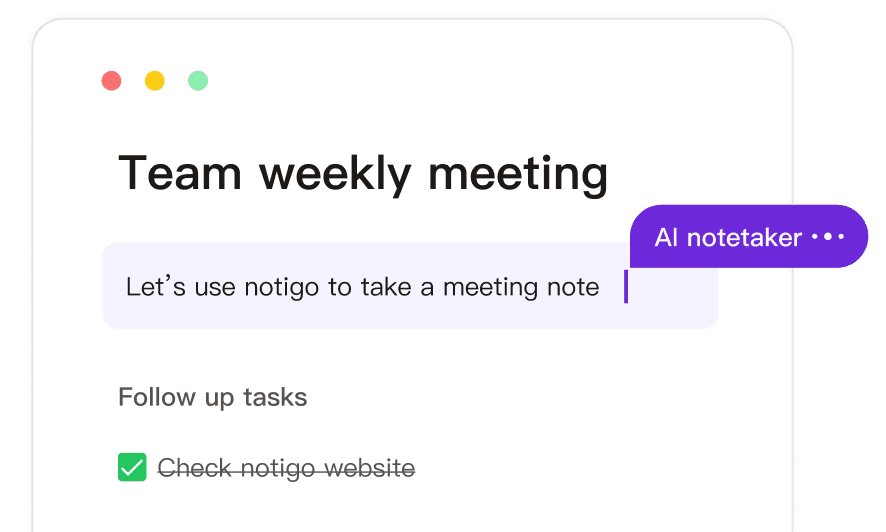


The best lecture recorder for business students is Notigo—an AI notepad that generates editable summaries in real-time as your professor speaks. Instead of scrambling to capture case study details or framework definitions, you get organized notes automatically structured by concept, allowing you to focus on understanding business strategy rather than frantically typing.
Business school is different from other majors. Your professors teach through case studies, real-world examples, and strategic frameworks that require you to think critically, not just memorize facts. When you're busy transcribing every word, you miss the chance to engage with the discussion, ask questions, or connect concepts to your own career goals. Notigo handles the note-taking so you can be present in class.
Why Business Lectures Require a Different Approach
Business education is built around application and discussion, not pure information transfer. Your Marketing professor doesn't just define the 4 Ps—they analyze how Apple's pricing strategy differs from Samsung's, discuss why certain product launches failed, and ask you to apply frameworks to real companies. Your Strategy class isn't about memorizing Porter's Five Forces—it's about using that framework to evaluate competitive dynamics in actual industries.
This creates a unique challenge: you need comprehensive notes for exam prep and case assignments, but you also need to actively participate in discussions. Traditional note-taking forces an impossible choice between capturing everything and engaging with the material. Miss the case details, and you can't complete the assignment. Miss the discussion, and you fail to develop the critical thinking skills that business school is supposed to build. Here's what makes business lectures particularly challenging:
- Case study heavy: Detailed company examples with financial data, strategic decisions, and outcomes you need to remember
- Framework application: Learning the framework is easy; understanding when and how to apply it requires active thinking
- Discussion-based learning: Professors ask questions and expect participation—hard to do while typing
- Multiple perspectives: Business problems rarely have one right answer; understanding different approaches matters
- Quantitative and qualitative mix: One minute you're discussing leadership theory, the next you're analyzing financial ratios
- Guest speakers and industry insights: Real professionals share experience that doesn't appear in textbooks
When you're frantically typing to capture a case study, you're not thinking about the strategic implications. You're a stenographer, not a business student developing analytical skills.
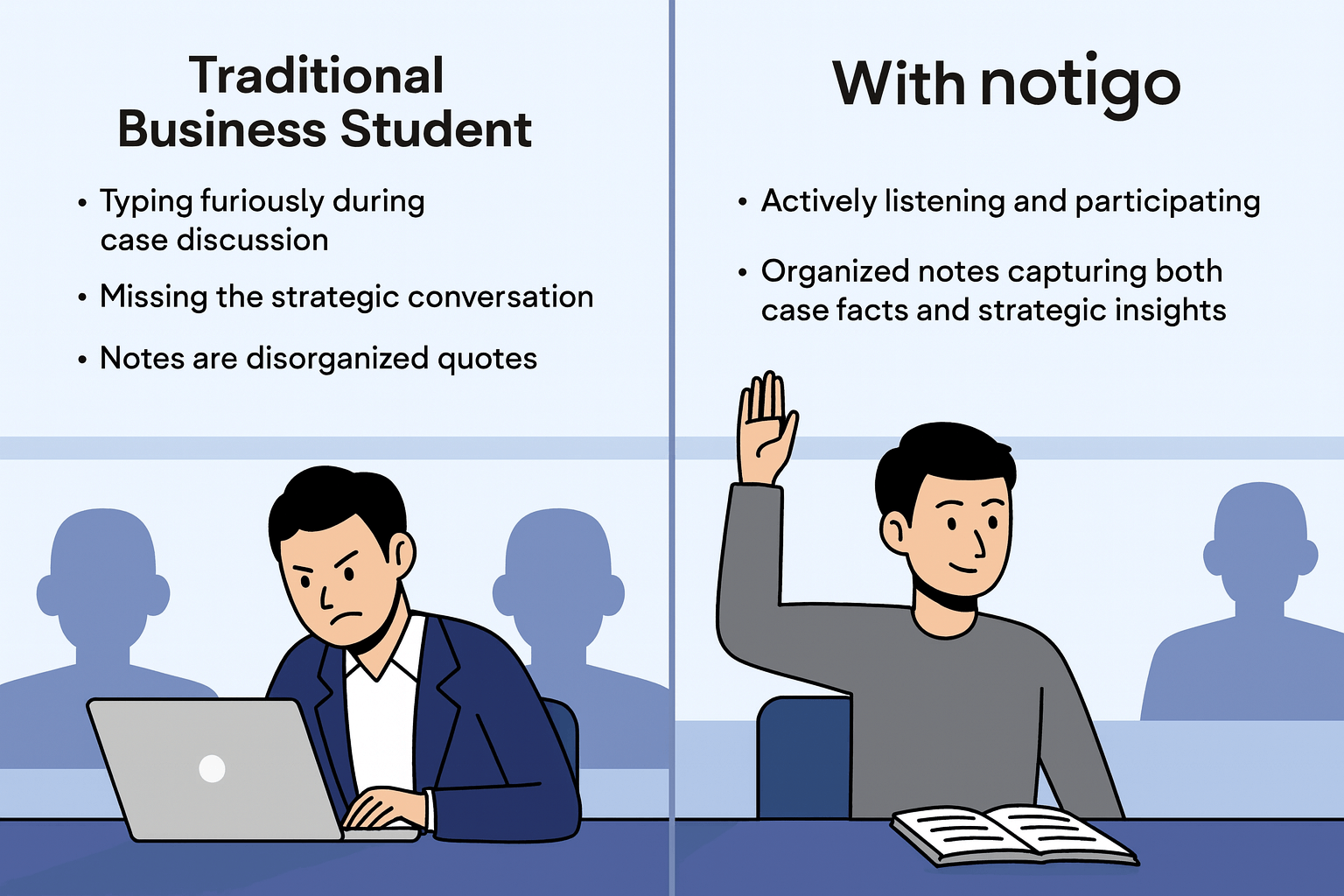
With Notigo, you'll be more prepared than ever - focus on participating and learning, not taking notes.
What Makes Notigo Different for Business Students
Most note-taking apps are built for either meetings or academic lectures, but business school is neither. You're not in a corporate meeting with action items, and you're not in a pure lecture where the professor talks for 90 minutes straight. Business classes are dynamic—cases, discussions, frameworks, examples, and guest speakers all mixed together.
Notigo adapts to this complexity automatically. It recognizes when your professor shifts from explaining a framework to analyzing a company example, or from presenting case facts to discussing strategic implications. You're not getting a transcript that mixes everything together—you're getting organized notes that separate concepts, cases, and applications. Here's why Notigo works specifically for business students:
What Notigo does for business classes:
- Captures case details automatically: Company names, financial figures, strategic decisions, and outcomes organized clearly
- Separates frameworks from applications: When your professor explains Porter's Five Forces then applies it to the airline industry, these become distinct sections
- Records guest speaker insights: Industry professionals share career advice and real-world experience—Notigo captures it without you missing the conversation
- Real-time editing for discussions: When a classmate makes a great point or your professor emphasizes something, add it immediately
- Handles quantitative content: Financial ratios, market data, and statistics are transcribed accurately
- Works for group projects: Record team meetings and strategy sessions to keep everyone aligned
The key difference: business school success isn't about perfect notes—it's about understanding strategy, thinking critically, and participating actively. Notigo handles documentation so you can focus on becoming a better business thinker.
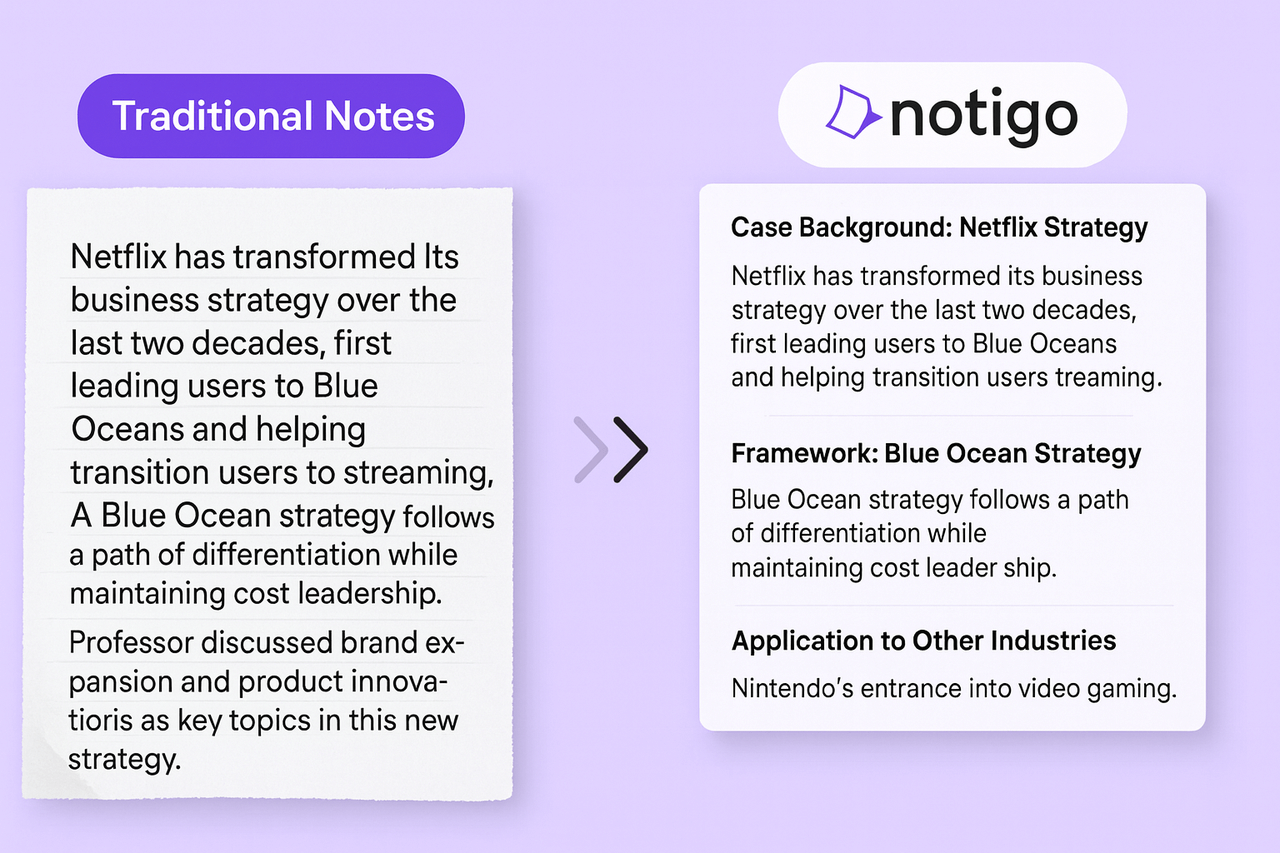
Get structured notes in real-time for free with Notigo.
How Business Students Use Notigo: The Complete Workflow
Business students juggle more than just lectures—you have group projects, networking events, guest speakers, and case competitions. You need a note-taking system that's flexible enough to handle all these contexts without requiring different tools or complicated setups. Notigo works the same way whether you're in Strategy class, meeting with your project team, or attending a speaker series.
The workflow reflects how successful business students actually operate: capture comprehensive information during learning experiences, synthesize key insights immediately after, then apply those insights to assignments, exams, and eventually your career. Here's how to use Notigo throughout your business school experience:
Before Class: Prepare for Engagement Open Notigo in your browser. If there's a case study assigned, skim it quickly so you understand the company and situation. When class starts, click record and then close your laptop lid slightly—this is the secret. You're recording, but your attention is on the discussion, not the screen.
During Class: Focus on Understanding, Not Typing Your Marketing professor is analyzing Coca-Cola's brand strategy. As they speak, Notigo transcribes and organizes automatically. You see sections forming:
- Coca-Cola Background and Market Position
- Brand Strategy Framework
- Competitive Positioning vs. Pepsi
- Discussion: Why Emotional Branding Works
What you should actually do during class:
- Ask questions when something isn't clear—you're not distracted by typing
- Participate in discussions with intelligent comments based on what you're actually hearing
- Make eye contact with your professor and classmates—you're part of the conversation
- Add quick highlights when your professor says "This will be on the exam" or "This is how real companies think about it"
- Note practical applications: "Could apply this framework to my summer internship project"
- Connect to readings: "This explains the article we read about brand equity"
You're being a business student—engaged, questioning, connecting ideas—not a transcription service.
After Class (10 minutes): Extract Strategic Insights Immediately after class, while the discussion is fresh, spend 10 minutes refining your notes:
- Summarize key takeaways in 2-3 bullet points: "Main insight: Brand value comes from emotional connection, not just product features"
- Add personal observations: "Noticed how luxury brands use scarcity differently than mass market brands"
- Link to other courses: "This brand strategy connects to the positioning map we learned in Marketing Fundamentals"
- Create action items: "Research how Tesla applies these principles" or "Use this framework for group project on streaming services"
This quick synthesis is what transforms information into understanding—the actual goal of business education.
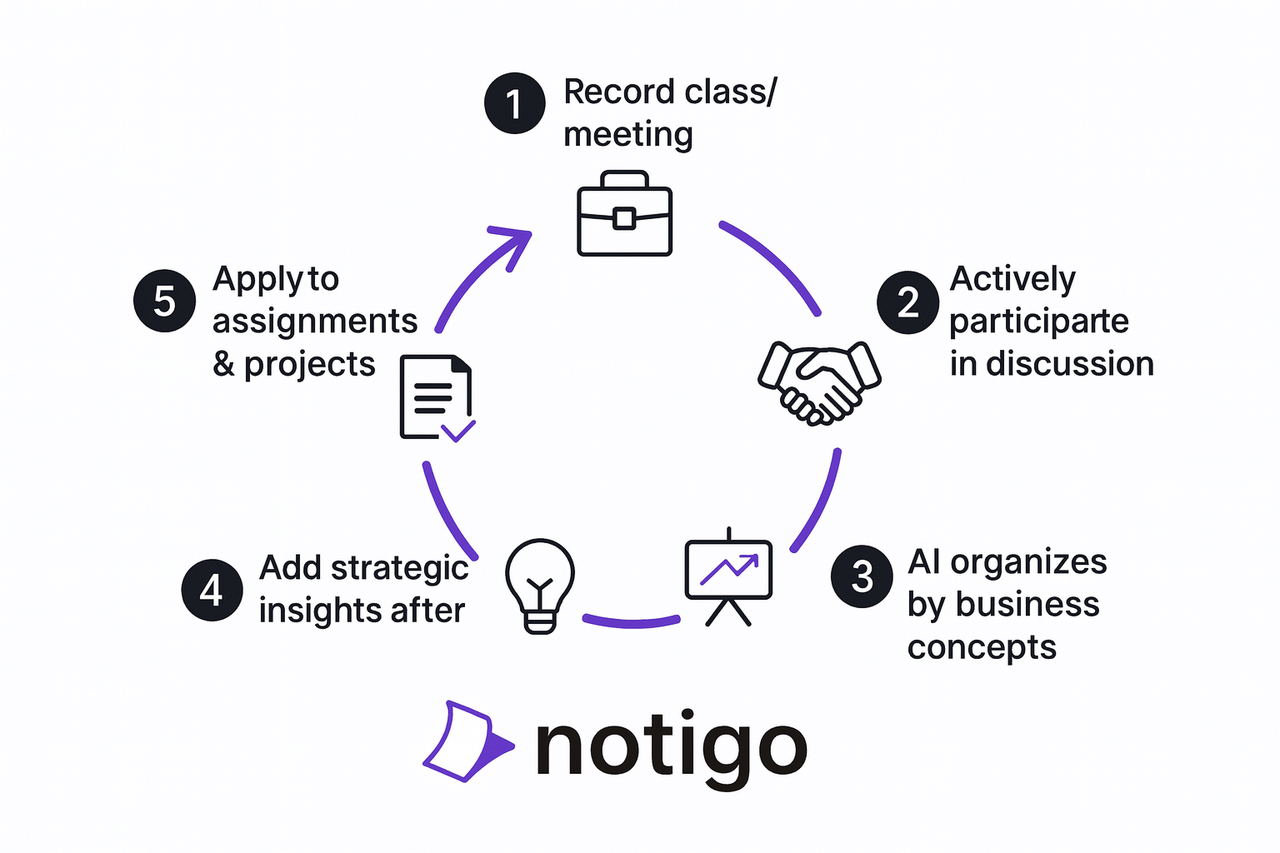
The workflow with Notigo couldn't be easier, and it's specifically fit for business students.
Real Example: Case Study Class Notes
Business school is built on case studies, and your ability to remember case details while understanding strategic implications determines your grades. Traditional note-taking makes you choose between capturing facts and understanding strategy. Notigo lets you do both.
Let's look at what happens during a typical Strategy class analyzing Airbnb's competitive strategy—this is actual business school content:
Traditional note-taking gives you: Either frantic bullet points mixing facts and strategy together incoherently, or you focus on discussion and have almost no notes afterward. Either way, you're unprepared for the case write-up due next week.
Notigo gives you:
Case Background: Airbnb
- Founded: 2008 by Brian Chesky, Joe Gebbia, Nathan Blecharczyk
- Business model: Online marketplace connecting hosts with guests, takes 3% from hosts and 6-12% from guests
- Growth: From air mattresses in San Francisco to 7+ million listings in 220+ countries
- Revenue 2023: $9.9 billion
- Key challenge: Competing against hotels while managing regulatory issues and quality control
Strategic Analysis: Blue Ocean Strategy
- Red ocean (hotels): Standardized experience, high costs, limited locations, predictable service
- Blue ocean (Airbnb): Unique stays, lower prices, everywhere, authentic local experience
- Value innovation: Eliminated hotel overhead, added local authenticity and variety
Competitive Advantages
- Network effects: More hosts attract more guests; more guests attract more hosts
- Trust systems: Reviews and verification create safety without direct control
- Technology platform: Matching algorithm, dynamic pricing, seamless booking
- Brand association: "Belong anywhere" positioning appeals to experiential travelers
Discussion Insights
- Prof's point: Airbnb succeeded by focusing on unserved market (budget travelers wanting authentic experience) rather than competing head-to-head with hotels
- Sarah's comment: Regulatory challenges in NYC and SF show limits of platform model when facing government pushback
- My observation: Could similar platform strategy work in other fragmented industries? (parking, storage, office space)
Application to Assignment
- Use this as example of platform business model for our group project on gig economy
- Compare Airbnb's trust system to Uber's rating system—similar principles?
This takes 4 minutes to review and gives you everything: case facts for the exam, strategic frameworks for essays, and discussion insights for your assignments.
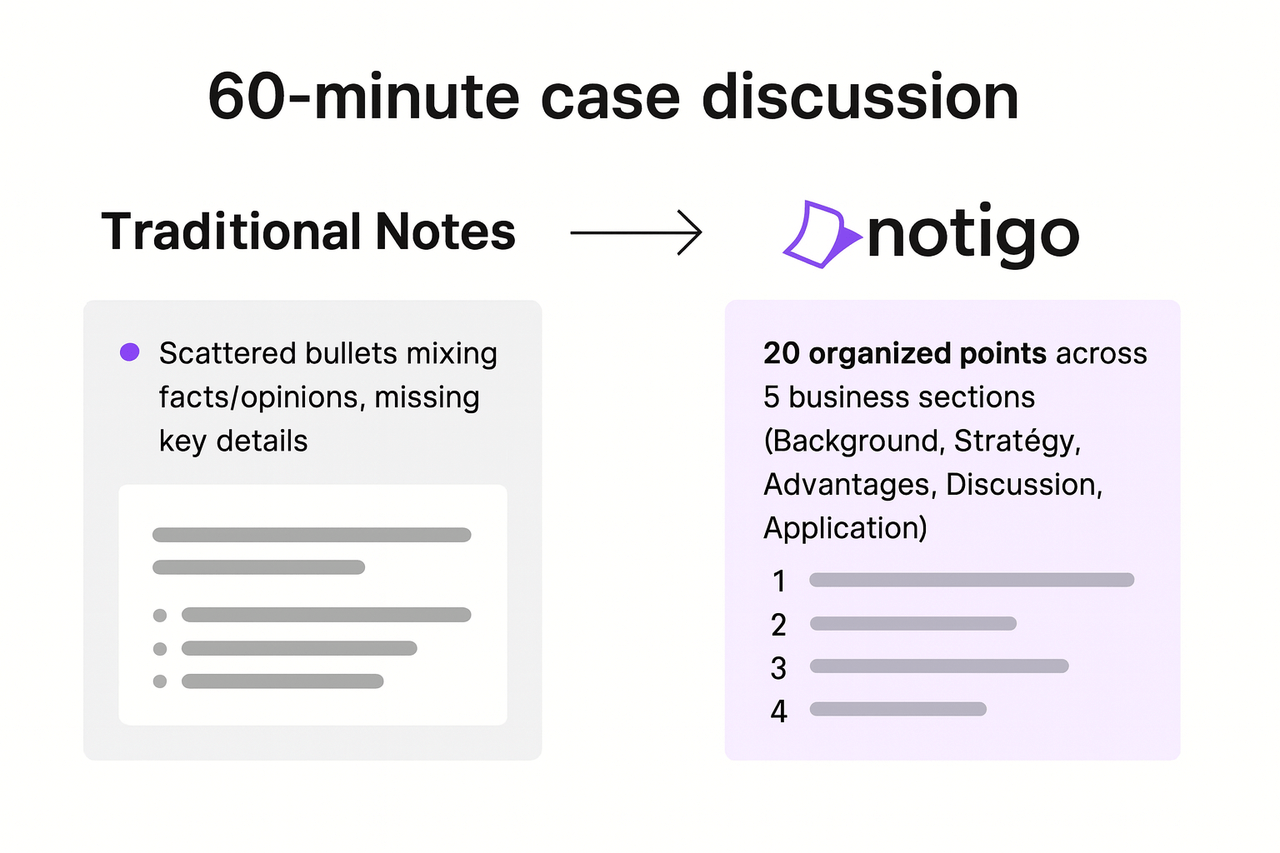
Notigo helps you remain clear and foucs on what's important by giving you structured insights from your lecture.
How Business Students Apply Notigo Beyond Lectures
Business school isn't just about classroom learning—it's about developing professional skills through projects, networking, and real-world application. The most successful business students find ways to capture and learn from every experience, not just formal lectures. Notigo adapts to the full range of business school activities.
Here are strategic ways business students use Notigo beyond traditional note-taking. Choose the applications that match your current priorities:
For group project meetings: Record your team meetings to keep everyone accountable and aligned. When your team discusses project strategy or divides responsibilities, Notigo captures who's doing what and by when. No more "I thought you were handling that" confusion. After meetings, share the organized notes so everyone has the same understanding of decisions and next steps.
For guest speaker sessions: Industry professionals share insights that never appear in textbooks—how they actually make decisions, what skills matter most, career advice based on real experience. Record these sessions and pay full attention to the speaker. Afterward, review your Notigo notes and extract the 3-4 most valuable insights. Many students create a "Career Insights" document compiling wisdom from every guest speaker they hear throughout business school.
For case competition preparation: When preparing for competitions like the CFA Research Challenge or marketing case comps, record your team's brainstorming sessions. Capture all the ideas, even the ones you don't pursue. Sometimes a "bad" idea from Thursday becomes the winning insight on Saturday when you're under pressure. Having comprehensive notes from all discussions means nothing gets lost.
For networking event follow-ups: After meeting someone interesting at a networking event, record yourself speaking for 2 minutes about the conversation—who they were, what you discussed, insights they shared, potential follow-up actions. Play this back through Notigo for organized notes. When you email them a week later, you'll remember specific details from your conversation rather than sending generic follow-ups.
For internship and work experiences: During summer internships, record yourself at the end of each day explaining what you learned. This creates a comprehensive record of your professional development. When it's time to interview for full-time positions, you'll have specific examples and insights to discuss rather than vague memories of "working on projects."
Creating executive summaries: For long readings or research, record yourself explaining the key points out loud as if presenting to an executive. Notigo transcribes your summary. This forces you to identify what actually matters (executives don't want details) and creates concise notes you can use later.
Integrating Notigo With Business School Success
Business school grades come from exams, case write-ups, projects, and class participation. The students who excel don't just take good notes—they build systems that connect their learning across all these evaluation methods. Your notes should feed directly into how you're actually being assessed.
The most effective approach: use Notigo to capture information, then immediately connect that information to your specific deliverables and goals. Here's how to build an integrated system:
Strategy 1: Notigo → Case Write-Up Preparation When you have a case assignment due, review all Notigo notes mentioning that company or similar strategic situations. Copy relevant frameworks and examples into your case write-up outline. You're starting with organized material rather than blank page syndrome. Students using this approach report cutting case prep time by 40% while improving analysis quality.
Strategy 2: Notigo → Exam Study Guides Create a master exam document organized by topic (Marketing Strategy, Financial Analysis, Operations, etc.). After each lecture, copy the key frameworks and definitions from your Notigo notes into the appropriate exam section. Add practice questions under each concept: "How would you apply SWOT analysis to evaluate Tesla's competitive position?" By exam time, you have a complete study guide that's been building all semester.
Strategy 3: Notigo → Class Participation Before each class, review the previous lecture's Notigo notes and prepare 2-3 questions or observations to share. This takes 5 minutes but dramatically improves your participation grade. You're not scrambling to think of something intelligent to say in the moment—you've already identified the interesting angles to explore.
Strategy 4: Notigo → LinkedIn Content and Job Applications Business students need to build professional brands. After interesting lectures or guest speakers, extract key insights from your Notigo notes and turn them into LinkedIn posts: "Three lessons from today's guest speaker on venture capital investing..." This demonstrates thought leadership to potential employers. When applying for jobs, your Notigo notes contain specific examples of business problems you've analyzed—use these in cover letters and interviews.
Strategy 5: Notigo → Business Idea Development Many business students start companies or side projects during school. Keep a dedicated "Business Ideas" document where you copy any interesting market insights, customer pain points, or strategic approaches from your Notigo notes. When entrepreneurship inspiration strikes, you have a library of frameworks and examples to draw from.
The pattern: don't just collect notes—use them strategically for the actual deliverables that determine your business school success.
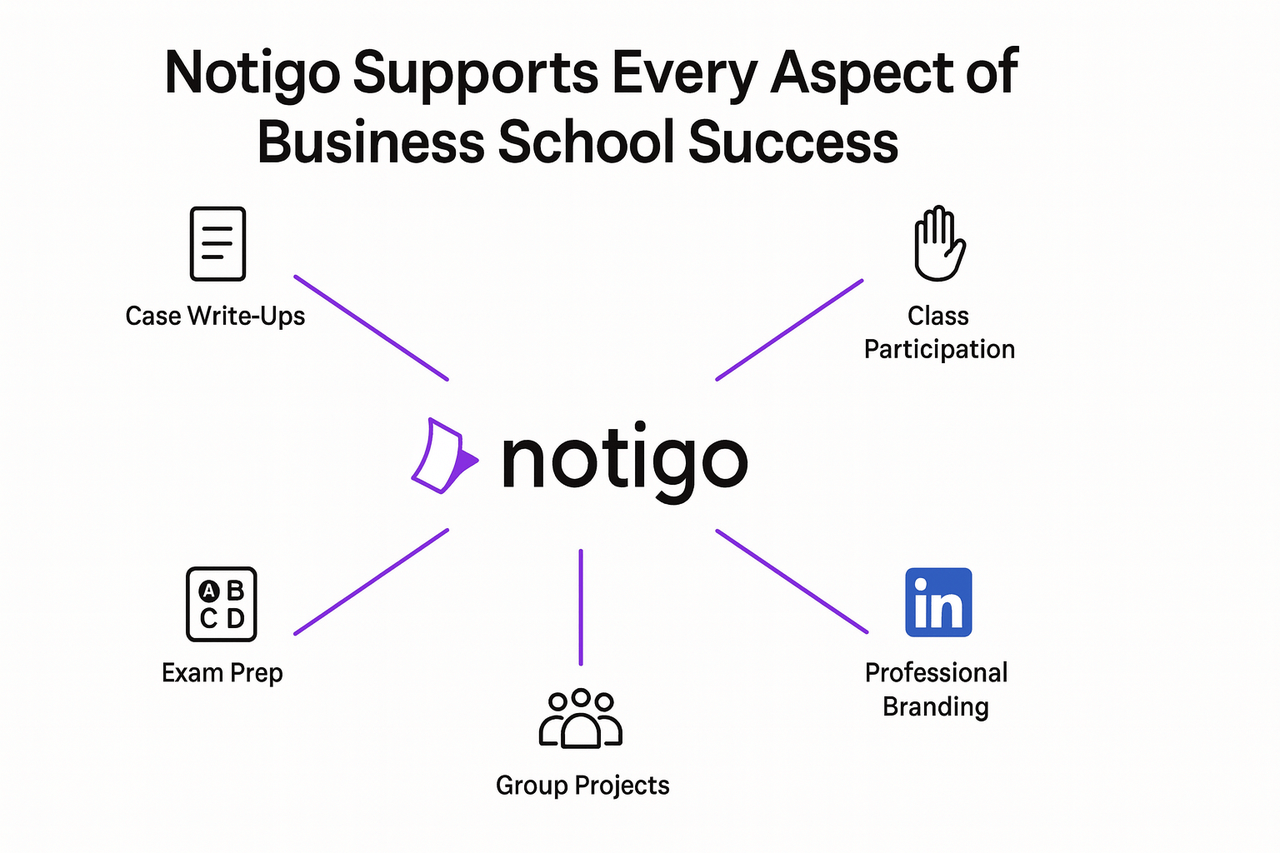
Notigo supports every aspect of business school success by synthesizing key information and allowing you to focus on studying.
FAQ
Can Notigo record business school group meetings and project discussions?
Yes, and this is one of Notigo's most valuable uses for business students. Record every group meeting to capture decisions, responsibilities, and ideas without anyone being stuck as the designated note-taker. Everyone can participate fully in the discussion. After meetings, share the organized Notigo notes with your team so everyone has the same understanding of what was decided and who's responsible for what. This dramatically reduces the "I thought you were doing that" confusion that derails group projects. Just make sure all team members consent to recording before you start.
How accurate is Notigo with business terminology and company names?
Notigo handles business terminology very well, achieving 90-95% accuracy on terms like "diversification," "synergy," "amortization," or "market segmentation." Company names, brands, and industry-specific jargon are typically transcribed correctly, though occasionally proper nouns might need correction. The real-time display means you catch and fix any errors immediately during class—if Notigo hears "gross margin" as "growth margin," you'll see it happen and correct it instantly. This is far better than discovering garbled notes when you're writing your case analysis at 2 AM the night before it's due.
Can I use Notigo to record MBA class discussions and debates?
Yes, Notigo excels at capturing discussion-based classes. When your Strategy professor facilitates a debate about whether vertical integration makes sense for electric vehicle companies, Notigo captures the various arguments and perspectives. The key is using Notigo to free you to actually participate in the debate rather than frantically typing everyone's comments. During heated discussions, add quick notes like "Strong point from Michael about supply chain risks" or "Counter-argument about capital requirements." After class, you'll have both the content of the discussion and your own observations about which arguments were most compelling.
Does Notigo work for guest speaker sessions and industry panels?
Absolutely—guest speakers are some of the most valuable but hardest-to-capture content in business school. Industry professionals share career insights, real-world decision-making processes, and lessons from experience that you won't find in textbooks. Record the entire session and focus entirely on listening, asking questions, and networking rather than typing notes. Afterward, review your Notigo notes and create a "Key Takeaways" section highlighting the 3-5 most valuable insights. Many students compile these takeaways from all guest speakers into a "Career Wisdom" document they reference throughout their careers.
Can I record business case competition strategy sessions?
Yes, recording case competition prep sessions is incredibly valuable. During the intense preparation period, your team generates dozens of ideas, analyses, and strategic approaches. Some get used in the final presentation, others get discarded. By recording all brainstorming and strategy sessions with Notigo, you capture everything without anyone being stuck taking notes instead of contributing ideas. Later, when you're refining your presentation, you can review earlier discussions to find that one insight someone mentioned on day one that's actually the key to your competitive advantage. Just ensure all team members are comfortable with recording before starting.
Should I use Notigo for finance and accounting classes with equations?
Notigo works well for the conceptual explanations in finance and accounting courses but has limitations with equations and calculations. When your Finance professor explains the logic behind net present value or why WACC matters for capital budgeting, Notigo captures those explanations perfectly. For actual equations and calculations shown on slides or the board, take photos with your phone or write them down separately. The best approach combines both: use Notigo for the "why" and "when" (conceptual understanding), and photos for the "how" (mathematical process). Many business students report that understanding the concepts actually matters more than memorizing formulas anyway.
How should I organize Notigo notes across different business courses?
Create folders for each course: "MKTG-601-Marketing-Strategy," "FIN-610-Corporate-Finance," "MGMT-620-Organizational-Behavior." Within each folder, name files by date and topic: "2025-11-19-Porter-Five-Forces" or "2025-11-19-Capital-Budgeting." For frameworks that appear across multiple courses (like SWOT analysis showing up in Strategy, Marketing, and Entrepreneurship), create a "Core Frameworks" folder where you compile all instances of that framework with examples from different contexts. Export everything to your preferred platform—Google Drive, Notion, or Evernote—for long-term access after graduation. These notes become a professional reference library you'll use throughout your career.
Can I use Notigo notes for job interviews and recruiting?
Yes, and this is an underrated benefit of organized business school notes. When preparing for consulting or corporate strategy interviews, review your Notigo notes from Strategy and Operations courses for frameworks and case examples. Interviewers ask "Tell me about a time you analyzed a complex business problem"—your Notigo notes contain dozens of cases you've studied in detail. Similarly, when preparing for a marketing interview at a consumer goods company, review your Marketing notes for brand strategy frameworks and real company examples. The specific, detailed examples in your notes make your interview answers more credible and impressive than generic responses.
The Bottom Line for Business Students
Business school is expensive and demanding. You're paying for more than just information—you're paying for the chance to develop strategic thinking, build professional networks, and learn from experienced faculty and guest speakers. Spending that time with your head down typing defeats the entire purpose.
Notigo changes the fundamental dynamic of business school. Instead of being the stenographer in the room, you become an active participant. You ask better questions because you're listening. You make stronger comments because you're thinking. You build better relationships with professors and classmates because you're making eye contact and engaging, not staring at your keyboard.
After class, you have comprehensive, organized notes without having sacrificed engagement. When it's time for case write-ups or exams, you're working from structured material that captures both facts and strategic insights. When you interview for jobs, you have a library of frameworks and examples to draw from.
The students who get the most value from business school aren't the ones with the prettiest notes. They're the ones who engage fully during class and then efficiently synthesize what they learned afterward. That's exactly what Notigo enables.
If you're tired of choosing between participation and documentation, try Notigo for your next business class. Let it handle the note-taking so you can focus on becoming the strategic thinker and business leader you're in school to become.